Mars: ground-based measurement
In this notebook we show an example of how we can use archNEMESIS to model the spectra from planetary atmospheres made using ground-based observatories and accounting for the telluric transmission and the Doppler shift. In particular, in this example we model a spectrum of the thermal emission from Mars’ atmosphere, simulating a spectrum similar to what we would observe with the TEXES instrument at the NASA Infrared Telescope Facility.
[1]:
import archnemesis as ans
import numpy as np
import matplotlib.pyplot as plt
from copy import deepcopy
1. Input files
First of all, we read the archNEMESIS HDF5 input file and explore some of the most relevant information within the classes.
[2]:
Atmosphere,Measurement,Spectroscopy,Scatter,Stellar,Surface,CIA,Layer,Variables,Retrieval,Telluric = ans.Files.read_input_files_hdf5('example_mars_groundbased')
nemesis :: Correcting for Doppler shift of 6.765723440871582 km/s
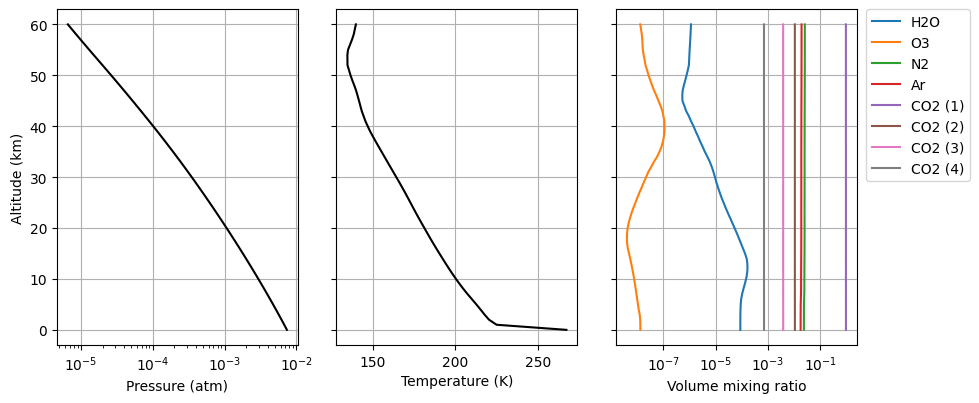
Atmosphere
[3]:
Atmosphere.plot_Atm()
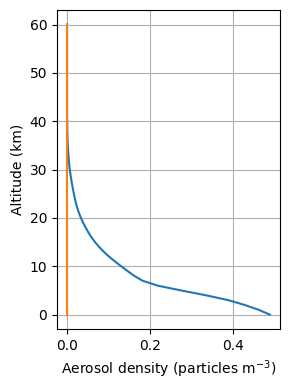
Atmosphere.plot_Dust()
Measurement
[4]:
Measurement.summary_info()
Spectral resolution of the measurement (FWHM) ::  0.012
Field-of-view centered at ::  Latitude 14.684788764515385 - Longitude -28.00760060502136
There are  1 geometries in the measurement vector

GEOMETRY 1
Minimum wavelength/wavenumber ::  920.0  - Maximum wavelength/wavenumber ::  930.0007999998583
Nadir-viewing geometry. Latitude ::  14.684788764515385  - Longitude ::  -28.00760060502136  - Emission angle ::  12.391185349136796  - Solar Zenith Angle ::  3.1490142200701006  - Azimuth angle ::  78.36504288953931
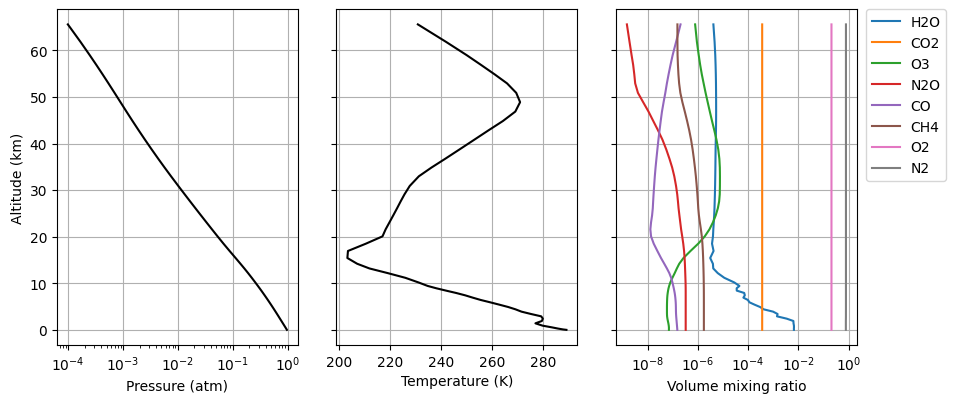
Telluric
[5]:
Telluric.Atmosphere.plot_Atm()
2. Calculating forward model
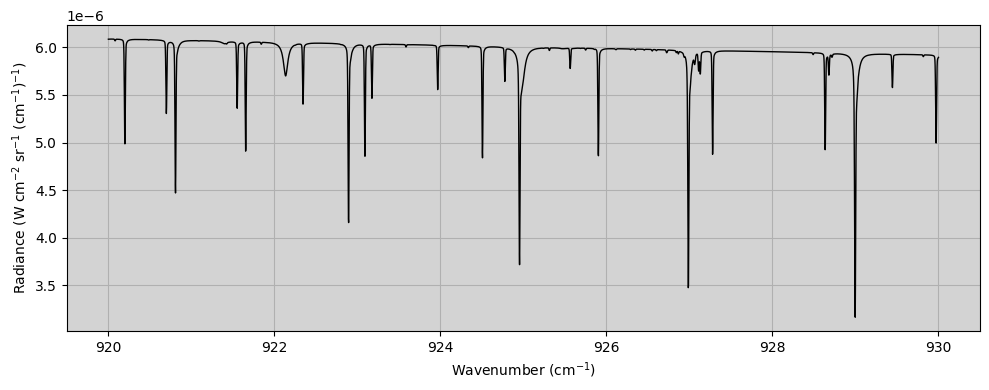
In this section, we are going to calculate a forward model, and then explore the contribution from different gases, the telluric transmission, and other useful parameters.
[7]:
ForwardModel = ans.ForwardModel_0(Atmosphere=Atmosphere,Surface=Surface,Measurement=Measurement,Spectroscopy=Spectroscopy,Stellar=Stellar,Scatter=Scatter,CIA=CIA,Layer=Layer,Variables=Variables,Telluric=Telluric)
SPECONV = ForwardModel.nemesisfm()
nemesis :: Correcting for Doppler shift of  6.765723440871582 km/s
nemesis :: Correcting for Doppler shift of  6.765723440871582 km/s
warning in .pat file :: ANGLE must be 0.0 for scattering calculations - resetting
CIRSrad :: CIA not included in calculations
CIRSrad :: Aerosol optical depths at  919.9995004749508  ::  [0.12748517 0.        ]
CIRSrad :: Performing multiple scattering calculation
CIRSrad :: NF =  10 ; NMU =  5 ; NPHI =  101
[8]:
fig,ax1 = plt.subplots(1,1,figsize=(10,4))

ax1.plot(Measurement.VCONV[:,0],SPECONV,c='black',linewidth=1.)
ax1.grid()
ax1.set_xlabel('Wavenumber (cm$^{-1}$)')
ax1.set_ylabel('Radiance (W cm$^{-2}$ sr$^{-1}$ (cm$^{-1}$)$^{-1}$)')
ax1.set_facecolor('lightgray')
plt.tight_layout()
2.1. Showing the effect of the telluric transmission
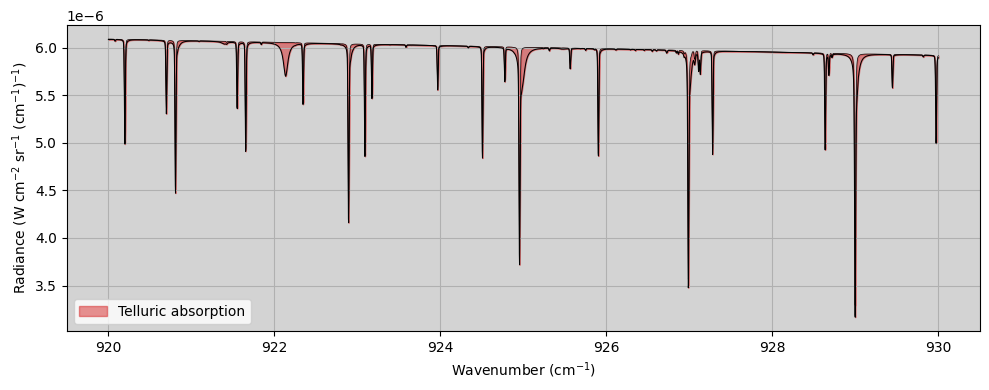
[9]:
ForwardModel = ans.ForwardModel_0(Telluric=None,Atmosphere=Atmosphere,Surface=Surface,Measurement=Measurement,Spectroscopy=Spectroscopy,Stellar=Stellar,Scatter=Scatter,CIA=CIA,Layer=Layer,Variables=Variables)
SPECONV_notell = ForwardModel.nemesisfm()
nemesis :: Correcting for Doppler shift of  6.765723440871582 km/s
nemesis :: Correcting for Doppler shift of  6.765723440871582 km/s
warning in .pat file :: ANGLE must be 0.0 for scattering calculations - resetting
CIRSrad :: CIA not included in calculations
CIRSrad :: Aerosol optical depths at  919.9995004749508  ::  [0.12748517 0.        ]
CIRSrad :: Performing multiple scattering calculation
CIRSrad :: NF =  10 ; NMU =  5 ; NPHI =  101
[10]:
fig,ax1 = plt.subplots(1,1,figsize=(10,4))

ax1.plot(Measurement.VCONV[:,0],SPECONV,c='black',linewidth=0.75)
ax1.plot(Measurement.VCONV[:,0],SPECONV_notell,c='black',linewidth=0.5)
ax1.fill_between(Measurement.VCONV[:,0],SPECONV[:,0],SPECONV_notell[:,0],alpha=0.5,color='tab:red',label='Telluric absorption')
ax1.legend()
ax1.grid()
ax1.set_xlabel('Wavenumber (cm$^{-1}$)')
ax1.set_ylabel('Radiance (W cm$^{-2}$ sr$^{-1}$ (cm$^{-1}$)$^{-1}$)')
ax1.set_facecolor('lightgray')
plt.tight_layout()
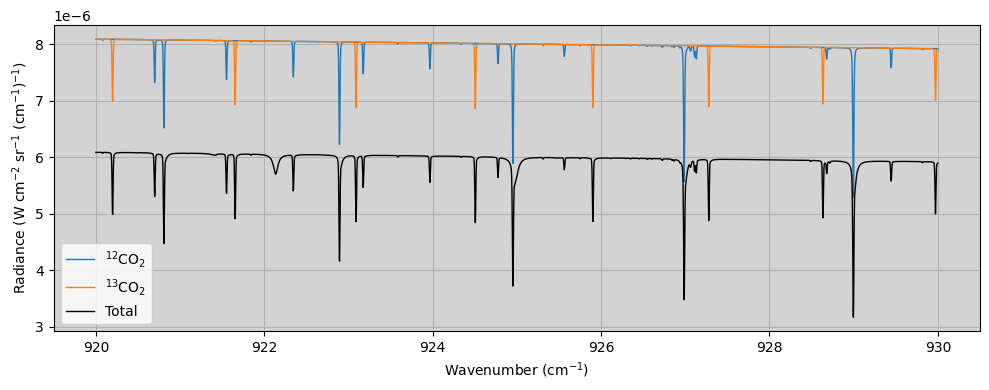
2.2. Showing the contribution from different gases to the spectrum
[11]:
#Getting the location of the lbl-tables
lbltables = Spectroscopy.LOCATION
nfm = len(lbltables)

SPECONV_gas = np.zeros((Measurement.NCONV[0],Measurement.NGEOM,nfm))
for i in range(nfm):

    #Defining only one gas in the spectroscopy
    Spectroscopy1 = deepcopy(Spectroscopy)
    Spectroscopy1.NGAS = 1
    Spectroscopy1.LOCATION = [lbltables[i]]
    Spectroscopy1.ID = [Spectroscopy.ID[i]]
    Spectroscopy1.ISO = [Spectroscopy.ISO[i]]
    Spectroscopy1.read_tables(wavemin=Measurement.WAVE.min(),wavemax=Measurement.WAVE.max())

    #Running the forward model
    ForwardModel = ans.ForwardModel_0(Atmosphere=Atmosphere,Surface=Surface,Measurement=Measurement,Spectroscopy=Spectroscopy1,Stellar=Stellar,Scatter=Scatter,CIA=CIA,Layer=Layer,Variables=Variables)
    SPECONV1 = ForwardModel.nemesisfm()

    #Saving the results
    SPECONV_gas[:,:,i] = SPECONV1[:,:]
nemesis :: Correcting for Doppler shift of  6.765723440871582 km/s
nemesis :: Correcting for Doppler shift of  6.765723440871582 km/s
warning in .pat file :: ANGLE must be 0.0 for scattering calculations - resetting
CIRSrad :: CIA not included in calculations
CIRSrad :: Aerosol optical depths at  919.9995004749508  ::  [0.12748517 0.        ]
CIRSrad :: Performing multiple scattering calculation
CIRSrad :: NF =  10 ; NMU =  5 ; NPHI =  101
nemesis :: Correcting for Doppler shift of  6.765723440871582 km/s
nemesis :: Correcting for Doppler shift of  6.765723440871582 km/s
warning in .pat file :: ANGLE must be 0.0 for scattering calculations - resetting
CIRSrad :: CIA not included in calculations
CIRSrad :: Aerosol optical depths at  919.9995004749508  ::  [0.12748517 0.        ]
CIRSrad :: Performing multiple scattering calculation
CIRSrad :: NF =  10 ; NMU =  5 ; NPHI =  101
[12]:
fig,ax1 = plt.subplots(1,1,figsize=(10,4))

offset = 2.e-6

for i in range(Spectroscopy.NGAS):

    if((Spectroscopy.ID[i]==2) & (Spectroscopy.ISO[i]==1)):
        label='$^{12}$CO$_2$'
    elif((Spectroscopy.ID[i]==2) & (Spectroscopy.ISO[i]==2)):
        label='$^{13}$CO$_2$'

    ax1.plot(Measurement.VCONV[:,0],SPECONV_gas[:,0,i]+offset,linewidth=1.,label=label)

ax1.plot(Measurement.VCONV[:,0],SPECONV,c='black',linewidth=1.,label='Total')

#ax1.plot(Measurement.VCONV[:,0],SPECONV_notell,c='black',linewidth=0.5)
#ax1.fill_between(Measurement.VCONV[:,0],SPECONV[:,0],SPECONV_notell[:,0],alpha=0.5,color='tab:red',label='Telluric absorption')
ax1.legend()
ax1.grid()
ax1.set_xlabel('Wavenumber (cm$^{-1}$)')
ax1.set_ylabel('Radiance (W cm$^{-2}$ sr$^{-1}$ (cm$^{-1}$)$^{-1}$)')
ax1.set_facecolor('lightgray')
plt.tight_layout()
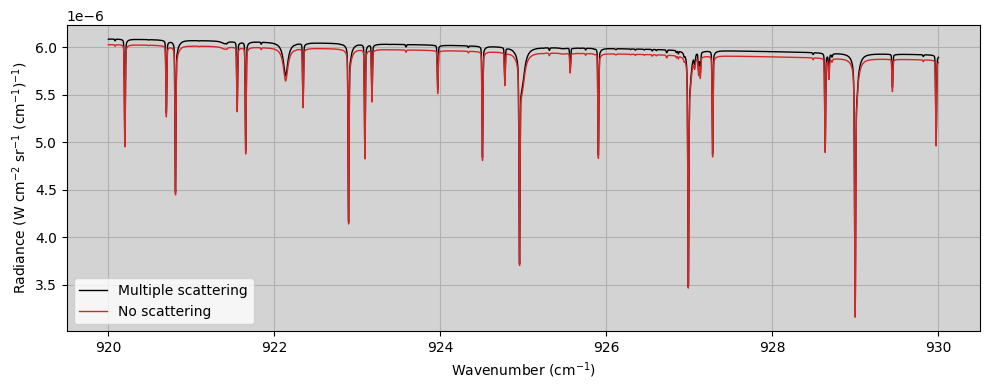
2.3. Showing the effect of multiple scattering
[13]:
Scatter.ISCAT = 0   #No scattering, only thermal emission
ForwardModel = ans.ForwardModel_0(Telluric=Telluric,Atmosphere=Atmosphere,Surface=Surface,Measurement=Measurement,Spectroscopy=Spectroscopy,Stellar=Stellar,Scatter=Scatter,CIA=CIA,Layer=Layer,Variables=Variables)
SPECONV_noscat = ForwardModel.nemesisfm()
Scatter.ISCAT = 1   #Resetting to multiple scattering
nemesis :: Correcting for Doppler shift of  6.765723440871582 km/s
nemesis :: Correcting for Doppler shift of  6.765723440871582 km/s
CIRSrad :: CIA not included in calculations
CIRSrad :: Aerosol optical depths at  919.9995004749508  ::  [0.12748517 0.        ]
CIRSrad :: Performing thermal emission calculation
[14]:
fig,ax1 = plt.subplots(1,1,figsize=(10,4))

ax1.plot(Measurement.VCONV[:,0],SPECONV,c='black',linewidth=1.,label='Multiple scattering')
ax1.plot(Measurement.VCONV[:,0],SPECONV_noscat,c='tab:red',linewidth=1.,label='No scattering')
ax1.legend()
ax1.grid()
ax1.set_xlabel('Wavenumber (cm$^{-1}$)')
ax1.set_ylabel('Radiance (W cm$^{-2}$ sr$^{-1}$ (cm$^{-1}$)$^{-1}$)')
ax1.set_facecolor('lightgray')
plt.tight_layout()